
“Stay strong like a crocodile—sometimes the toughest armor hides the biggest smiles!” 🐊💪🌞
Step by Step Drawing Tutorial of a Cute Crocodile for Kids
Learn how to draw a cute crocodile with this fun and easy step-by-step tutorial for kids and beginners! Crocodiles are powerful reptiles that have lived since the time of dinosaurs, making them a perfect subject for wildlife-themed art projects, classroom lessons, and homeschool activities. Using simple shapes and easy drawing steps, kids will love creating their very own crocodile drawing while learning amazing crocodile facts!
Don’t forget to prepare your materials. Please see my post on how to use the Grid Line Method here. By the way we have prepared a free downloadable Grid Lined Paper that you can use, click the link to download a copy. Please note that these free downloads are intended for personal use only.💖
You may print it on an A4 sized paper or if you want to draw on a smaller scale, you may print 2 copies on one A4 sized paper.
Let’s Draw a Crocodile!
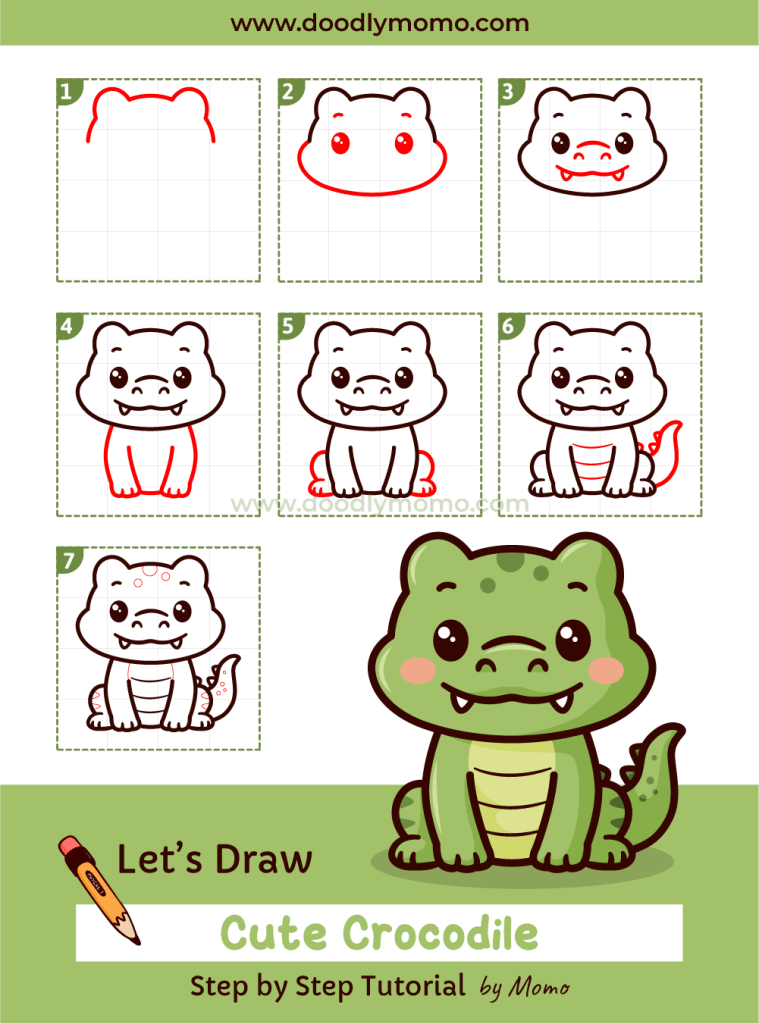
Step 1: First, draw the top part of the head of the crocodile, focusing on the elongated shape that resembles a triangle with rounded edges. Begin by sketching a smooth curve that arches upwards, and then let it taper off toward each end to create a natural look.

Step 2: Next, draw the bottom part of the face of the crocodile, ensuring to capture its distinct shape and features. Add two small curves for eyebrows that lend character to your drawing, making the crocodile appear either fierce or friendly, depending on your style. Then, draw two circles for the eyes, positioning them appropriately to reflect the crocodile’s keen sense of sight. Don’t forget to add small circles for eye glare, which will give your drawing depth and bring it to life.

Step 3: Then, draw the snout of the crocodile, ensuring to capture its distinctive shape, which tapers slightly at the end, where you will draw the smiling mouth. Create a gentle curve for the smile that conveys a sense of friendliness, and don’t forget to add two sharp teeth on both sides of the mouth, emphasizing their formidable nature.

Step 4: Draw both front legs of the crocodile, ensuring they are positioned proportionately to the body. Start by outlining the basic shape of the legs, focusing on the muscular structure that supports the crocodile’s weight. Add details such as the toes, which should be slightly spread to give it a more natural stance.
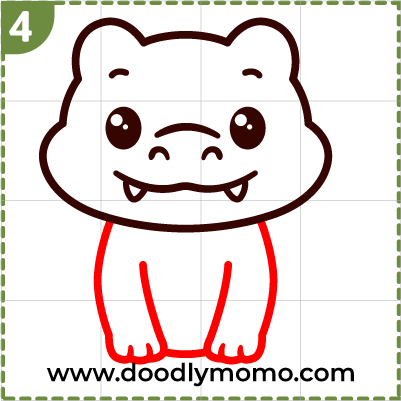
Step 5: Next, draw both back legs of the crocodile, ensuring they are positioned correctly to reflect the animal’s cute sitting stance. Take your time to make each leg proportionate, as this will give your drawing a sense of realism and strength.
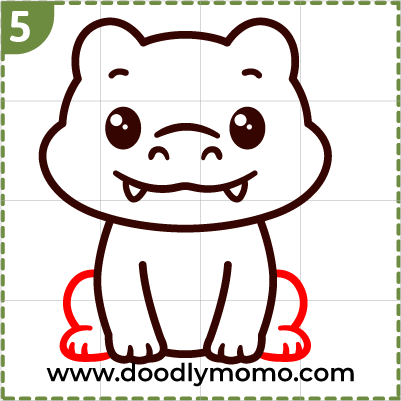
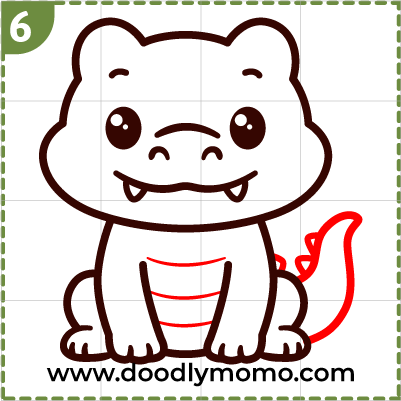
Step 6: Then, draw the tail of the crocodile, ensuring it tapers to a sharp point for a fierce appearance. Add a prominent, pointy spike on both the tail and the back side of the crocodile, enhancing its reptilian features and making it look more intimidating. Don’t forget to incorporate curved lines along the tummy to add additional detail and texture; these lines will mimic the natural scales and give your crocodile a more realistic look.
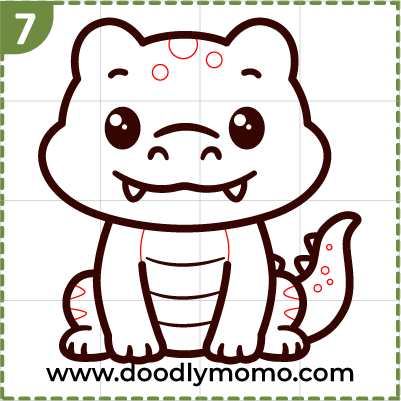
Step 7: Lastly, draw additional thin lines for details on the body of the crocodile, carefully adding texture to the scales to make them look more realistic. Focus on varying the thickness of the lines to create depth, and consider how the light would reflect off the surfaces. By adding these intricate details, you will enhance the overall appearance of your drawing, giving it a lifelike quality that captures the essence of a crocodile’s rugged skin. If you enjoyed this step by step crocodile drawing tutorial, you might also like our how to draw a Siamese cat step by step—it’s another fun and easy guide perfect for beginners and kids!
Here are all the detailed steps for your easy reference, ensuring that you can follow along without any confusion as you work through the process. Each step is meticulously outlined to provide clarity, allowing you to navigate through the procedure with ease and confidence. By following this structured approach, you will minimize the chances of making mistakes and increase your efficiency as you progress. Feel free to refer back to this guide whenever you need a reminder or a clearer understanding of the process.
Did you know?
Crocodiles are some of the oldest animals on Earth, living since the time of the dinosaurs? These powerful reptiles have tough, scaly skin and super strong jaws filled with sharp teeth. Crocodiles spend lots of time in the water, where they can hold their breath for over an hour! They are sneaky hunters, able to stay almost completely underwater with just their eyes and nose showing. Crocodiles eat fish, birds, and sometimes larger animals, snapping with lightning speed. Even though they look scary, crocodiles are important for keeping rivers and lakes healthy.
Here’s some more kid-friendly information:
- Ancient reptiles. Crocodiles have been living on Earth for over 200 million years—since the time of dinosaurs!
- Long lives. Some crocodiles can live up to 70 years or more in the wild.
- Mighty jaws. Their jaws are among the strongest in the animal kingdom, with 60–70 sharp teeth.
- Super breath-holders. Crocodiles can stay underwater for over an hour without coming up for air.
- Fast movers. They are excellent swimmers and can dash quickly on land when needed.
- Hungry hunters. Crocodiles eat fish, birds, and sometimes even large animals like zebras.
- Giants of the water. Some crocodiles grow longer than 20 feet—bigger than a car!
- Baby talk. Crocodile hatchlings chirp from inside their eggs to tell mom they’re ready to come out.
- Sunbathers. As cold-blooded reptiles, they warm themselves by lying in the sun.
- Nature’s balance-keepers. Crocodiles help keep rivers and lakes healthy by controlling other animal populations.
Did you know? Crocodiles can hold their breath for over an hour, while hummingbirds need to eat every 10–15 minutes to survive. See the contrast by following our step-by-step hummingbird drawing tutorial
📌We are in Pinterest too! Check us out and save our pins as reference! ♥
You can also check and buy vector files and images from our Adobe Stock link below, where you’ll find a diverse collection catering to all your creative needs, ensuring that you have quality visuals for any project, whether it be for web design, marketing, or personal use.
Thank you for reading! We hope you found this article insightful and enjoyable. Please have a look at our other step-by-step tutorials, where you can discover a variety of adorable dog breeds, including tips on training, grooming, and care. Whether you’re a seasoned dog owner or considering bringing a new furry friend into your home, our comprehensive guides are designed to help you along the way. Happy Drawing!



 Doodlymomo

Leave a comment