
“Swim with confidence like a shark—but don’t forget, even the toughest fish need time to just float and relax!” 🦈🌊
Step by Step Drawing Tutorial of a Cute Shark for Kids
Learn how to draw a cute shark with this fun and easy step-by-step tutorial for kids and beginner artists! This friendly cartoon shark is perfect for ocean-themed art projects, classroom lessons, or just for fun. Using simple shapes and kid-friendly steps, your little artist will be ready to bring their shark drawing to life in no time!
Don’t forget to prepare your materials. Please see my post on how to use the Grid Line Method here. By the way we have prepared a free downloadable Grid Lined Paper that you can use, click the link to download a copy. Please note that these free downloads are intended for personal use only.💖
You may print it on an A4 sized paper or if you want to draw on a smaller scale, you may print 2 copies on one A4 sized paper.
Let’s Draw a Shark!
Step 1: First, draw the shape of the face and top of the head of the shark, ensuring that you capture the distinctive contour that characterizes this magnificent creature. Start by sketching a smooth, curved line that defines the forehead and gently slopes downwards towards the snout.

Step 2: Next, draw a big curve for the bottom tummy of the shark, ensuring that the curve is smooth and rounded to give it a natural appearance. This shape will serve as the foundation for the shark’s body, gradually widening towards the sides. Take your time to make the curve proportional, as it will help establish the shark’s overall posture and design, reflecting its powerful and streamlined silhouette as it glides through the ocean waters.

Step 3: Then, draw the back part of the shark connecting to the tail, making sure to capture its sleek shape, which is important for swimming efficiently. Highlight the curve of the back, as this helps the shark stay balanced and agile in the water. Draw the tail, noting its powerful lobes that allow for quick speed bursts, essential for chasing prey and avoiding threats.

Step 4: Draw two circles for the eyes of the shark, ensuring they are proportionate to the size of the head to capture the fierce expression typical of these creatures. Add additional small circles within the eyes for eye’s glare, giving them a lively, gleaming look that adds character to your drawing. Next, draw the big mouth of the shark, curving it downward to emphasize its predatory nature; don’t forget to incorporate sharp teeth that detail the menacing aspect of the shark.

Step 5: Next, draw the teeth of the sharks, ensuring to create five prominent, sharp teeth on the upper jaw and four equally impressive teeth on the lower jaw, giving them a fierce appearance. Don’t forget to include the tongue as well, making it slightly visible within the open mouth.

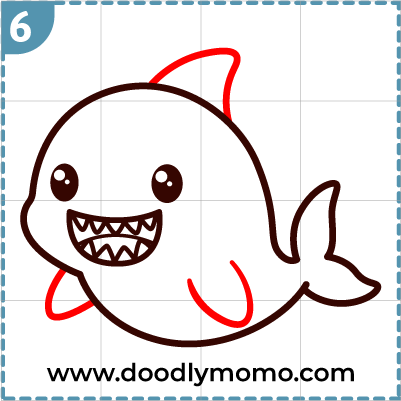
Step 6: Begin by carefully drawing both fins of the shark, ensuring to capture their distinct shapes and sizes. The pectoral fins should be broad and slightly angled, resembling wings in their spread, while the dorsal fin, which is the prominent big fin on the back of the shark, should stand tall and sturdy, almost like a sail against the water. Pay attention to the textures and curves of each fin, as they play a vital role in the shark’s ability to maneuver through the ocean depths with grace and power.
Step 7: Lastly, draw two small curves for the gills of the shark, ensuring they are positioned symmetrically on either side of the head to accurately represent the anatomy of this magnificent creature. Emphasize the gentle arch of each curve, as this detail adds to the realism of your drawing. Additionally, draw further details using thin lines to indicate the texture of the skin around the gills and to create a sense of depth. Now that you’ve finished your awesome shark drawing, soar into our step-by-step Eagle drawing tutorial and learn to draw one of the most powerful birds in the sky!

Here are all the detailed steps for your easy reference, ensuring that you can follow along without any confusion as you work through the process. Each step is meticulously outlined to provide clarity, allowing you to navigate through the procedure with ease and confidence. By following this structured approach, you will minimize the chances of making mistakes and increase your efficiency as you progress. Feel free to refer back to this guide whenever you need a reminder or a clearer understanding of the process.

Did you know?
Sharks have been swimming in the oceans for more than 400 million years—long before dinosaurs? These amazing creatures come in all sizes, from tiny sharks that fit in your hand to giant whale sharks as big as a bus! Sharks don’t have bones; their bodies are made of cartilage, the same stuff in your nose and ears. They have super senses, like being able to smell a single drop of blood in the water from far away. Some sharks give birth to live pups, while others lay special egg cases called “mermaid’s purses.” Sharks are important to the ocean because they help keep other fish populations balanced. Even though they look fierce, most sharks are not dangerous to humans. Instead, they are fascinating ocean guardians that keep the sea healthy and full of life!

Here’s some more kid-friendly information:
- Super survivors! Sharks have lived in the ocean for more than 400 million years—way before dinosaurs walked the Earth.
- Tiny to giant! The smallest shark, the dwarf lantern shark, is only 6 inches long, while the whale shark can be as long as a school bus.
- No bones about it! Sharks don’t have bones—just cartilage, the bendy stuff in your nose and ears.
- Tooth factories! Sharks have rows and rows of teeth, and when one falls out, another grows right back.
- Baby sharks! Some sharks hatch from egg cases called “mermaid’s purses,” while others are born live, ready to swim.
- Ocean detectives. Sharks have amazing senses—they can smell tiny drops of blood, hear faraway sounds, and sense vibrations in the water.
- Rough and tough. If you touched a shark, its skin would feel like sandpaper because of tiny scales called denticles.
- Always moving. Some sharks must keep swimming all the time to breathe, but others can rest on the ocean floor and pump water through their gills.
- Gentle giants. Whale sharks are the largest fish in the world, but they eat tiny plankton instead of big prey.
- Ocean protectors. Sharks help balance the ocean by keeping fish populations healthy, making them super important for the sea.
Did you know? Some sharks can detect a single drop of blood in the water from miles away! Dive into our step-by-step Dolphin drawing tutorial for another amazing sea creature to sketch!
📌We are in Pinterest too! Check us out and save our pins as reference! ♥
You can also check and buy vector files and images from our Adobe Stock link below, where you’ll find a diverse collection catering to all your creative needs, ensuring that you have quality visuals for any project, whether it be for web design, marketing, or personal use.
Thank you for reading! We hope you found this article insightful and enjoyable. Please have a look at our other step-by-step tutorials, where you can discover a variety of adorable dog breeds, including tips on training, grooming, and care. Whether you’re a seasoned dog owner or considering bringing a new furry friend into your home, our comprehensive guides are designed to help you along the way. Happy Drawing!




 Doodlymomo

Leave a comment